

C
A
I
D
O
Z
ZODIAC
Building real connections through a shared language people already speak._
A cross-platform mobile app for astrology-driven community building.
ZODIAC — Case Study by TINT Tech
THE BRIEF
What we set out to build
Zodiac started with a frustration. Two people, both tired of dating apps that had stopped being about connections and started being about collecting matches. The ego hit of a new match had become the product, not what came after it. We wanted to build something different — but different how?
The answer came from something we already knew. In any conversation, with anyone, the question always comes up eventually. What's your sign? When's your birthday? Astrology is one of those rare things that people are genuinely curious about in each other. It's a natural opener. It gives you a reason to ask.
But the real problem we kept coming back to wasn't dating. It was something broader. People are meeting each other less. Not because they don't want to — but because the habits of real interaction are quietly being replaced by passive ones. You don't ask your friend how they're doing anymore, you watch their story. You don't reach out, because reaching out feels like it means something, and that vulnerability got quietly labeled as weakness somewhere along the way. The result is that people are more visible to each other than ever, and more isolated at the same time.
Zodiac is built around the idea that connection needs a spark. Something small enough to feel easy, meaningful enough to go somewhere. Your star sign is that spark.
THE PIVOT
Finding the better version of the idea
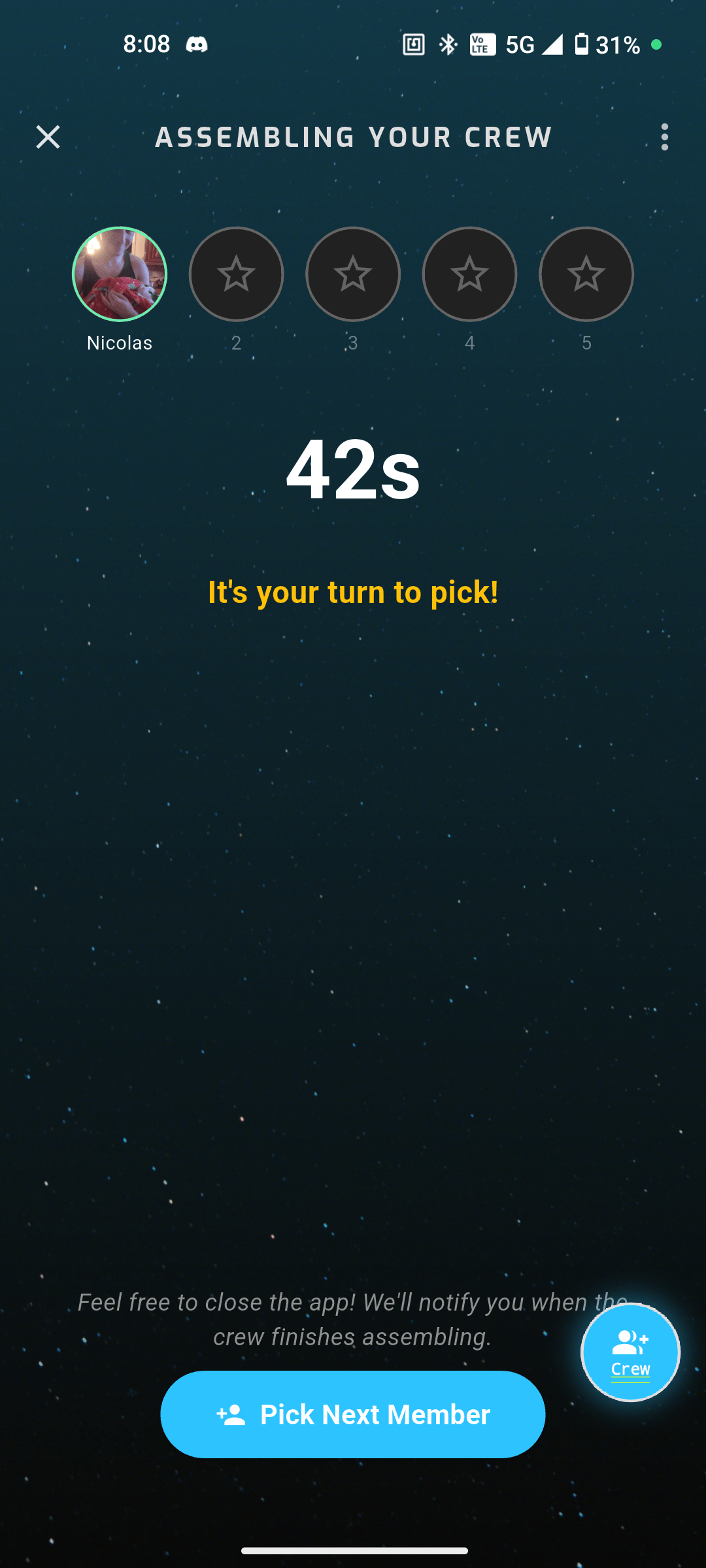
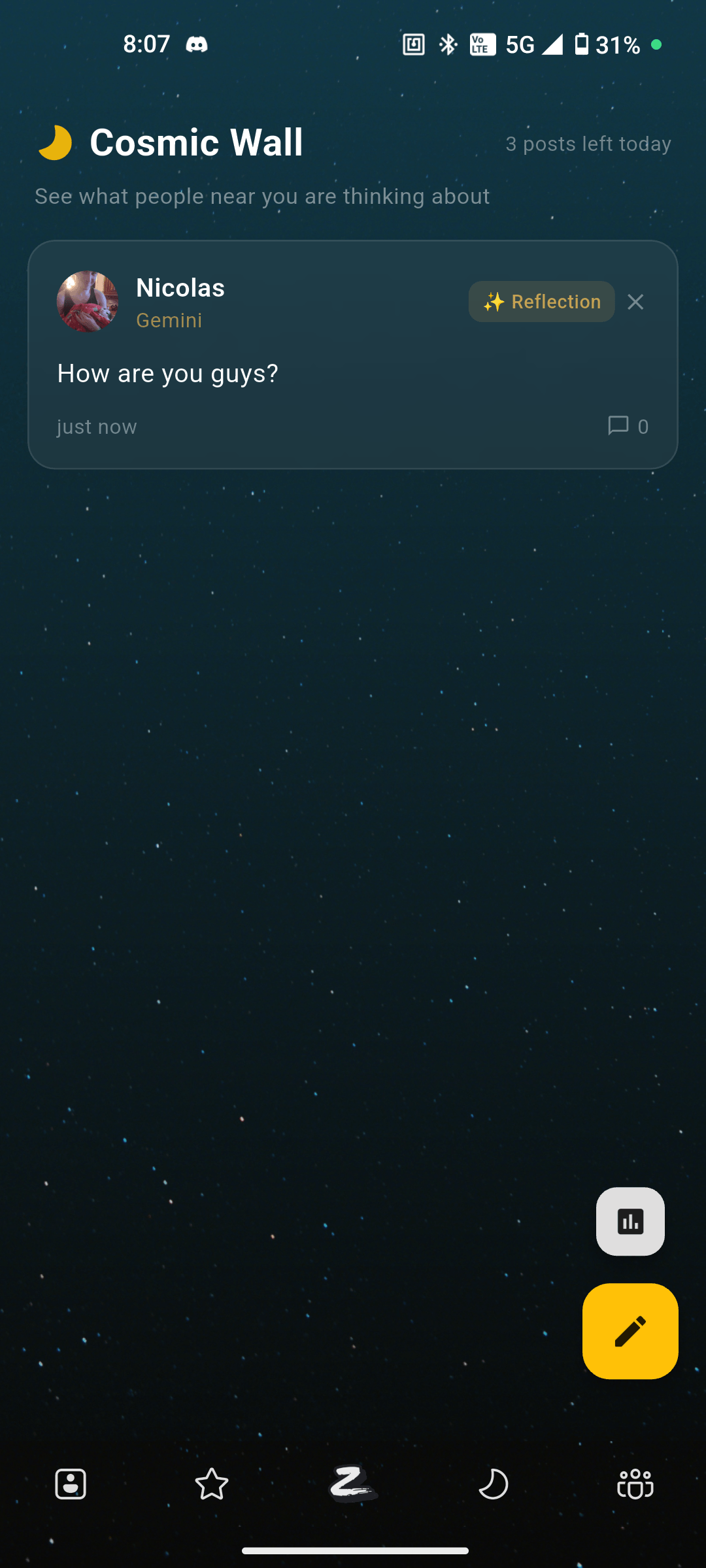
The signal didn't come from data. It came from conversations. Not from my close circle — things there were fine — but further out, in the wider network of people around us. Friends of friends. Acquaintances. People who had quietly ended up stuck. Stuck in friendships that weren't really friendships, in situations they hadn't chosen so much as defaulted into, because the alternative — starting over, putting yourself out there, building something new — felt harder than just staying put. Disconnected, but not alone. Which is almost a lonelier place to be.
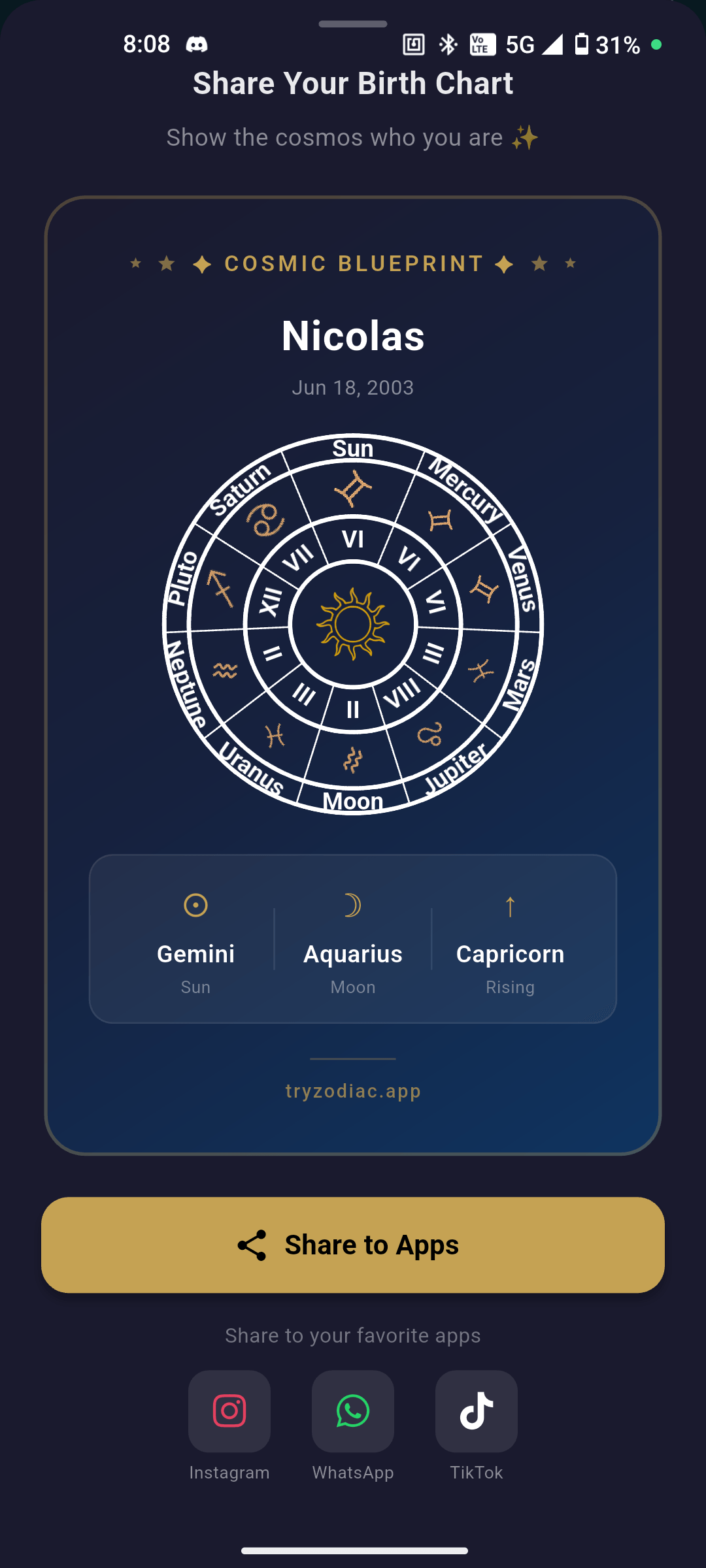
I looked at what we'd already built — the astrology infrastructure, the compatibility engine, the birth charts — and realized we were sitting on something that could actually speak to that problem. Dating was a hard space to crack and an even harder one to do differently. Community wasn't. And the tools were already there.
So I made the call. Zodiac stopped trying to be a dating app and started being something more honest — a place to meet people, full stop. Not romantically, not transactionally. Just people, finding others they might actually want to know.
EARLY TRACTION
200+ wishlists. No marketing spend.
Zodiac hasn't launched yet. There's no marketing budget, no ad campaigns, no influencer posts. And there are already over 200 people waiting for it.
They found us through the Play Store — searching, browsing, landing on the profile through tags and SEO. Nobody sent them there. They showed up because they were already looking for something like this, and we happened to be the answer.
That number matters less as a vanity metric and more as a signal. It means the idea resonates without being sold. It means there's a room full of people waiting at the door before we've even opened it.
The launch is coming. Both platforms, at the same time.
[200+]
Wishlist Sign-ups
Zero paid marketing
[$0]
Acquisition Cost
100% organic discovery
[2]
Platforms
iOS & Android, simultaneous
PRODUCT DECISIONS
What we built and why
Some of the most important decisions in building Zodiac weren't about what to add — they were about what to reject.
No popularity mechanics
The most deliberate one was the decision to not build an ELO system. Most social and dating apps rank you by popularity — how many people swiped right, how many matched, how many messages you got. It sounds neutral but it isn't. It turns people into a score based on how desirable others find them, and it rewards the wrong things.
Zodiac uses a reliability system instead. Your standing in the app is shaped by how you show up — whether you follow through, whether you treat people with basic respect, whether you ghost or engage. How many people want to talk to you doesn't move the needle. How you behave does. It's a small architectural decision that says something about what the app actually values.
A coordinated launch
The simultaneous launch on iOS and Android was a choice, not a constraint. Zodiac is a community app, and communities need people. Launching on one platform first and waiting for the other to catch up means starting with a fractured user base at the exact moment when density matters most. We'd rather wait and open both doors at the same time.
Navigating the App Store
The road to the App Store took longer than expected. Apple's guidelines around dating apps are strict, and the original version of Zodiac ran into that wall. The community pivot wasn't only a product decision — it was also the right response to that reality. Sometimes external pressure points you toward the better version of what you were building anyway.
DESIGN
Built to feel like the content
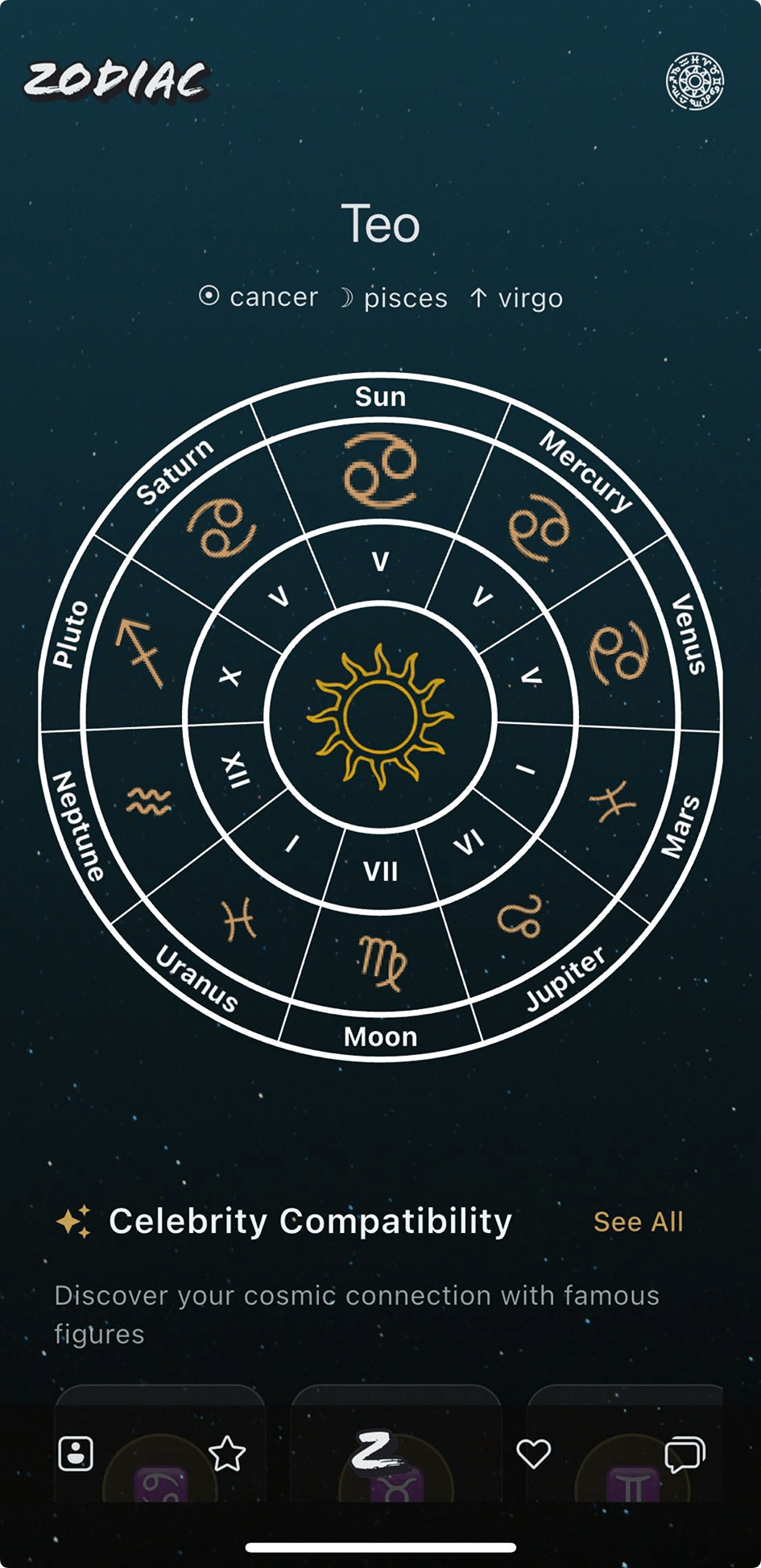
The core of Zodiac isn't about some shallow "social discovery" trend; it's about fixing the fundamental decay of human interaction. We've created a system where astrology acts as the high-fidelity spark for connections that actually go somewhere.
The aesthetic isn't just "dark mode" because it's trendy; it's a deliberate psychological choice to kill the ego-driven dopamine hits found in legacy platforms. By utilizing #020F14 as our primary void, we've built a reflective atmosphere that allows the user's birth chart to be the focal point.
We selected Exo as our primary display face because its geometric, slightly futuristic curves establish a sense of precision and openness to the app. For the core interface copy, we transitioned to Poppins to handle the heavy lifting of readability. This contrast between bold, structural headers and clean, functional body text gives a sense of deep familiarity, strengthening the app's overall feel.
WHERE IT'S GOING
The launch is the starting line
Zodiac already has a clear picture of what comes next — and it goes deeper into everything the first version establishes.
On the near-term side, AI-powered cosmic icebreakers will suggest conversation starters based on actual chart compatibility between two people — not generic openers, but ones that reference specific planetary placements you share. A retrograde monitor will keep the community ahead of cosmic shifts. The synastry tracker will bring daily relationship dynamics to any connection in the app.
Further out, tarot readings integrated with astrological insights, a full astro calendar, and a smarter Discovery 2.0 algorithm that factors in transits and synastry aspects — not just sign compatibility — are all in the pipeline.
The through-line across all of it is the same as the core product: less surface-level, more substance. Features that give people something real to talk about, and reasons to keep coming back.
[01]
THE BRIEF
What we set out to build
Zodiac started with a frustration. Two people, both tired of dating apps that had stopped being about connections and started being about collecting matches. The ego hit of a new match had become the product, not what came after it. We wanted to build something different — but different how?
The answer came from something we already knew. In any conversation, with anyone, the question always comes up eventually. What's your sign? When's your birthday? Astrology is one of those rare things that people are genuinely curious about in each other. It's a natural opener. It gives you a reason to ask.
But the real problem we kept coming back to wasn't dating. It was something broader. People are meeting each other less. Not because they don't want to — but because the habits of real interaction are quietly being replaced by passive ones. You don't ask your friend how they're doing anymore, you watch their story. You don't reach out, because reaching out feels like it means something, and that vulnerability got quietly labeled as weakness somewhere along the way. The result is that people are more visible to each other than ever, and more isolated at the same time.
Zodiac is built around the idea that connection needs a spark. Something small enough to feel easy, meaningful enough to go somewhere. Your star sign is that spark.
[02]
THE PIVOT
Finding the better version of the idea
The signal didn't come from data. It came from conversations. Not from my close circle — things there were fine — but further out, in the wider network of people around us. Friends of friends. Acquaintances. People who had quietly ended up stuck. Stuck in friendships that weren't really friendships, in situations they hadn't chosen so much as defaulted into, because the alternative — starting over, putting yourself out there, building something new — felt harder than just staying put. Disconnected, but not alone. Which is almost a lonelier place to be.
I looked at what we'd already built — the astrology infrastructure, the compatibility engine, the birth charts — and realized we were sitting on something that could actually speak to that problem. Dating was a hard space to crack and an even harder one to do differently. Community wasn't. And the tools were already there.
So I made the call. Zodiac stopped trying to be a dating app and started being something more honest — a place to meet people, full stop. Not romantically, not transactionally. Just people, finding others they might actually want to know.
[03]
EARLY TRACTION
200+ wishlists. No marketing spend.
Zodiac hasn't launched yet. There's no marketing budget, no ad campaigns, no influencer posts. And there are already over 200 people waiting for it.
They found us through the Play Store — searching, browsing, landing on the profile through tags and SEO. Nobody sent them there. They showed up because they were already looking for something like this, and we happened to be the answer.
That number matters less as a vanity metric and more as a signal. It means the idea resonates without being sold. It means there's a room full of people waiting at the door before we've even opened it.
The launch is coming. Both platforms, at the same time.
[200+]
Wishlist Sign-ups
Zero paid marketing
[$0]
Acquisition Cost
100% organic discovery
[2]
Platforms
iOS & Android, simultaneous
[04]
PRODUCT DECISIONS
What we built and why
Some of the most important decisions in building Zodiac weren't about what to add — they were about what to reject.
No popularity mechanics
The most deliberate one was the decision to not build an ELO system. Most social and dating apps rank you by popularity — how many people swiped right, how many matched, how many messages you got. It sounds neutral but it isn't. It turns people into a score based on how desirable others find them, and it rewards the wrong things.
Zodiac uses a reliability system instead. Your standing in the app is shaped by how you show up — whether you follow through, whether you treat people with basic respect, whether you ghost or engage. How many people want to talk to you doesn't move the needle. How you behave does. It's a small architectural decision that says something about what the app actually values.
A coordinated launch
The simultaneous launch on iOS and Android was a choice, not a constraint. Zodiac is a community app, and communities need people. Launching on one platform first and waiting for the other to catch up means starting with a fractured user base at the exact moment when density matters most. We'd rather wait and open both doors at the same time.
Navigating the App Store
The road to the App Store took longer than expected. Apple's guidelines around dating apps are strict, and the original version of Zodiac ran into that wall. The community pivot wasn't only a product decision — it was also the right response to that reality. Sometimes external pressure points you toward the better version of what you were building anyway.
[05]
DESIGN
Built to feel like the content
The core of Zodiac isn't about some shallow "social discovery" trend; it's about fixing the fundamental decay of human interaction. We've created a system where astrology acts as the high-fidelity spark for connections that actually go somewhere.
The aesthetic isn't just "dark mode" because it's trendy; it's a deliberate psychological choice to kill the ego-driven dopamine hits found in legacy platforms. By utilizing #020F14 as our primary void, we've built a reflective atmosphere that allows the user's birth chart to be the focal point.
We selected Exo as our primary display face because its geometric, slightly futuristic curves establish a sense of precision and openness to the app. For the core interface copy, we transitioned to Poppins to handle the heavy lifting of readability. This contrast between bold, structural headers and clean, functional body text gives a sense of deep familiarity, strengthening the app's overall feel.
[06]
WHERE IT'S GOING
The launch is the starting line
Zodiac already has a clear picture of what comes next — and it goes deeper into everything the first version establishes.
On the near-term side, AI-powered cosmic icebreakers will suggest conversation starters based on actual chart compatibility between two people — not generic openers, but ones that reference specific planetary placements you share. A retrograde monitor will keep the community ahead of cosmic shifts. The synastry tracker will bring daily relationship dynamics to any connection in the app.
Further out, tarot readings integrated with astrological insights, a full astro calendar, and a smarter Discovery 2.0 algorithm that factors in transits and synastry aspects — not just sign compatibility — are all in the pipeline.
The through-line across all of it is the same as the core product: less surface-level, more substance. Features that give people something real to talk about, and reasons to keep coming back.
tryzodiac.app >
More Projects
Want something like this?